Research
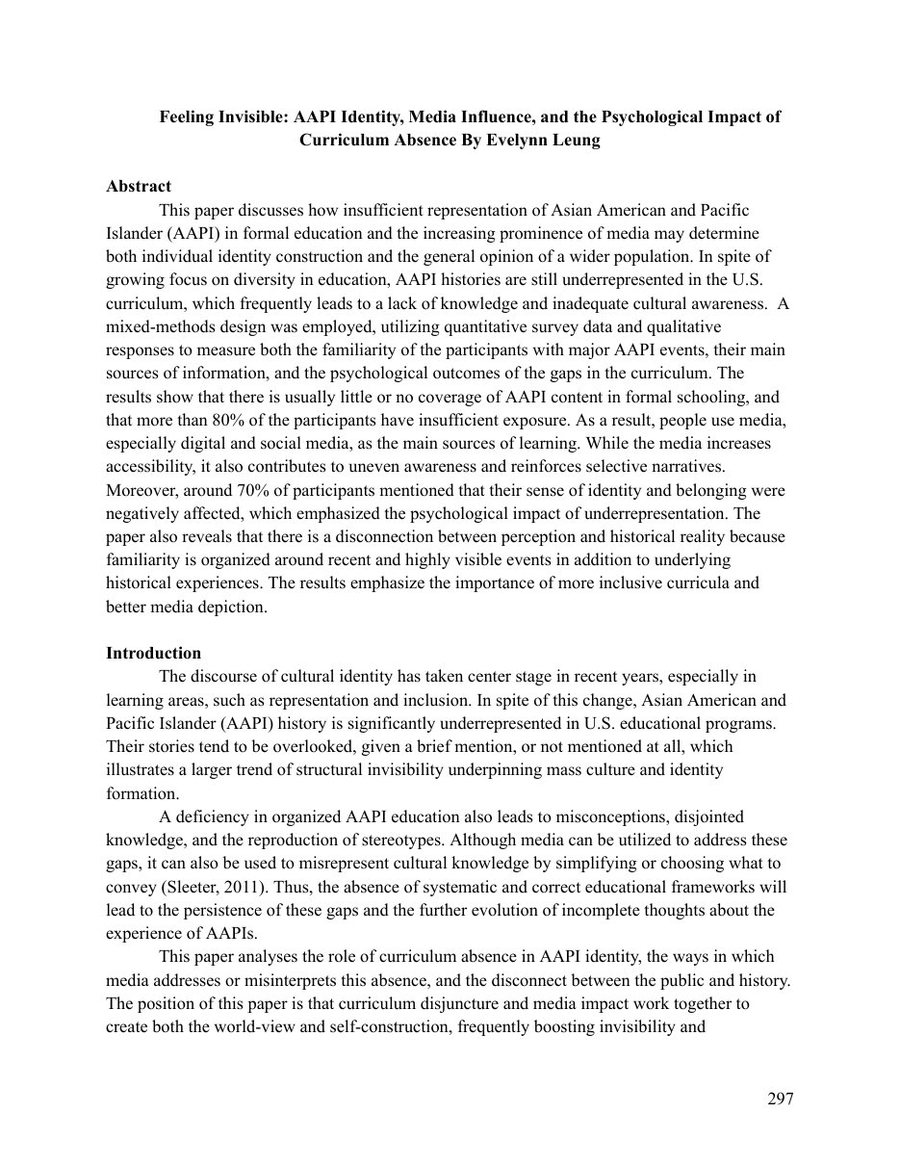
Feeling Invisible: AAPI Identity, Media Influence, and the Psychological Impact of Curriculum Absence
I created and conducted my own survey to explore how the lack of AAPI history in school curricula can shape students’ understanding of identity and belonging. I found that many participants had little exposure to AAPI history in school and instead learned through social and digital media. My research was later published in the Curieux Academic Journal.
Curieux Academic JournalJune 2026 · Issue 8, Part 2 · pg. 297
Scholarly Review JournalFall 2026 · Issue 17 · doi:10.70121/001c.169630
Abstract · Curieux Academic Journal
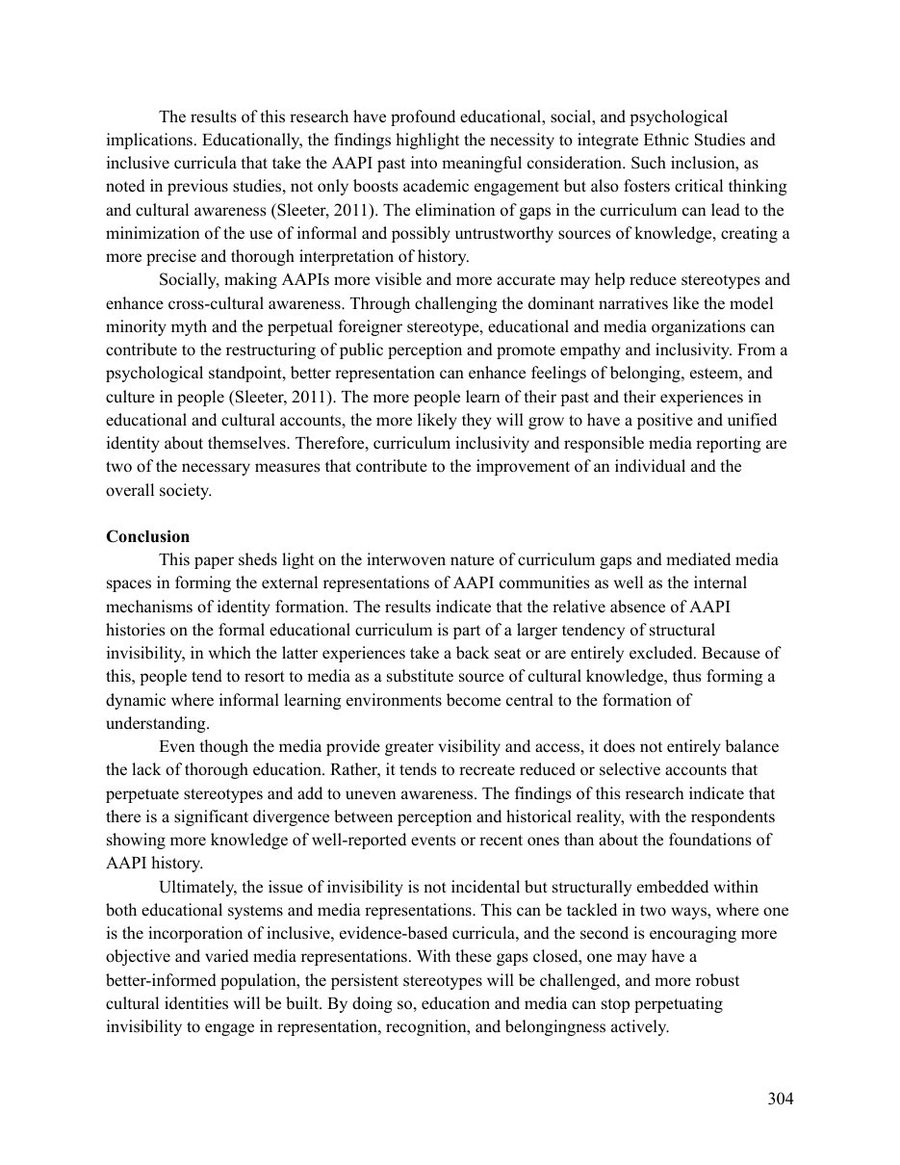
This paper discusses how insufficient representation of Asian American and Pacific Islander (AAPI) in formal education and the increasing prominence of media may determine both individual identity construction and the general opinion of a wider population. In spite of growing focus on diversity in education, AAPI histories are still underrepresented in the U.S. curriculum, which frequently leads to a lack of knowledge and inadequate cultural awareness. A mixed-methods design was employed, utilizing quantitative survey data and qualitative responses to measure both the familiarity of the participants with major AAPI events, their main sources of information, and the psychological outcomes of the gaps in the curriculum. The results show that there is usually little or no coverage of AAPI content in formal schooling, and that more than 80% of the participants have insufficient exposure. As a result, people use media, especially digital and social media, as the main sources of learning. While the media increases accessibility, it also contributes to uneven awareness and reinforces selective narratives. Moreover, around 70% of participants mentioned that their sense of identity and belonging were negatively affected, which emphasized the psychological impact of underrepresentation. The paper also reveals that there is a disconnection between perception and historical reality because familiarity is organized around recent and highly visible events in addition to underlying historical experiences. The results emphasize the importance of more inclusive curricula and better media depiction.
Abstract · Scholarly Review Journal
This paper explores the underrepresentation of the history of Asian American and Pacific Islander (AAPI) people in formal education and the role of media, including social and digital media, in shaping identity formation. The study builds on recent scholarship and ethnic studies theories, with a particular focus on issues of curricular gaps, systemic exclusion, intersectional diversity, and the mental health consequences of underrepresentation. As a result, existing literature shows that when learning about Asian-American cultures is limited in the school curriculum, students use the media as a source of information to affirm themselves and reinforce stereotypes. Additionally, limited representation leads to invisible experiences and a lack of belonging, which impacts self-concept and resilience. Thus, this paper highlights the need for inclusive curricula, culturally responsive pedagogy, and policy changes that incorporate meaningful representation of AAPI histories, inclusive learning spaces, critical thinking, and positive identity development. The research also reveals that education and media can work together to bridge these gaps and strengthen cultural awareness, social justice, and student empowerment in various educational settings.
Keywords: AAPI identity, curriculum absence, media representation, ethnic studies, identity formation, cultural invisibility, education inequality, stereotype formation, psychological impact, social perception
2026